


Hi everyone! I hope you’re all taking care of yourselves, ‘cos this timeline is just crazy…
You’re reading the free weekly Crypto is Macro Now, where I re-share a couple of the week’s premium posts as well as some non-crypto and non-macro links of interest.
💮 If you’re not a subscriber to the premium dailies, I hope you’ll consider becoming one! For the price of a weekly cup of coffee, you’ll get access to market commentary as well as adoption insight and industry trends. Plus, links and music recommendations ‘cos why not… 💮
PUBLISHED IN PARTNERSHIP WITH: ✨ ALLIUM ✨
As traditional finance and crypto converge, trusted data is the missing infrastructure layer. Allium provides this data foundation for teams like Visa, Stripe and Grayscale.
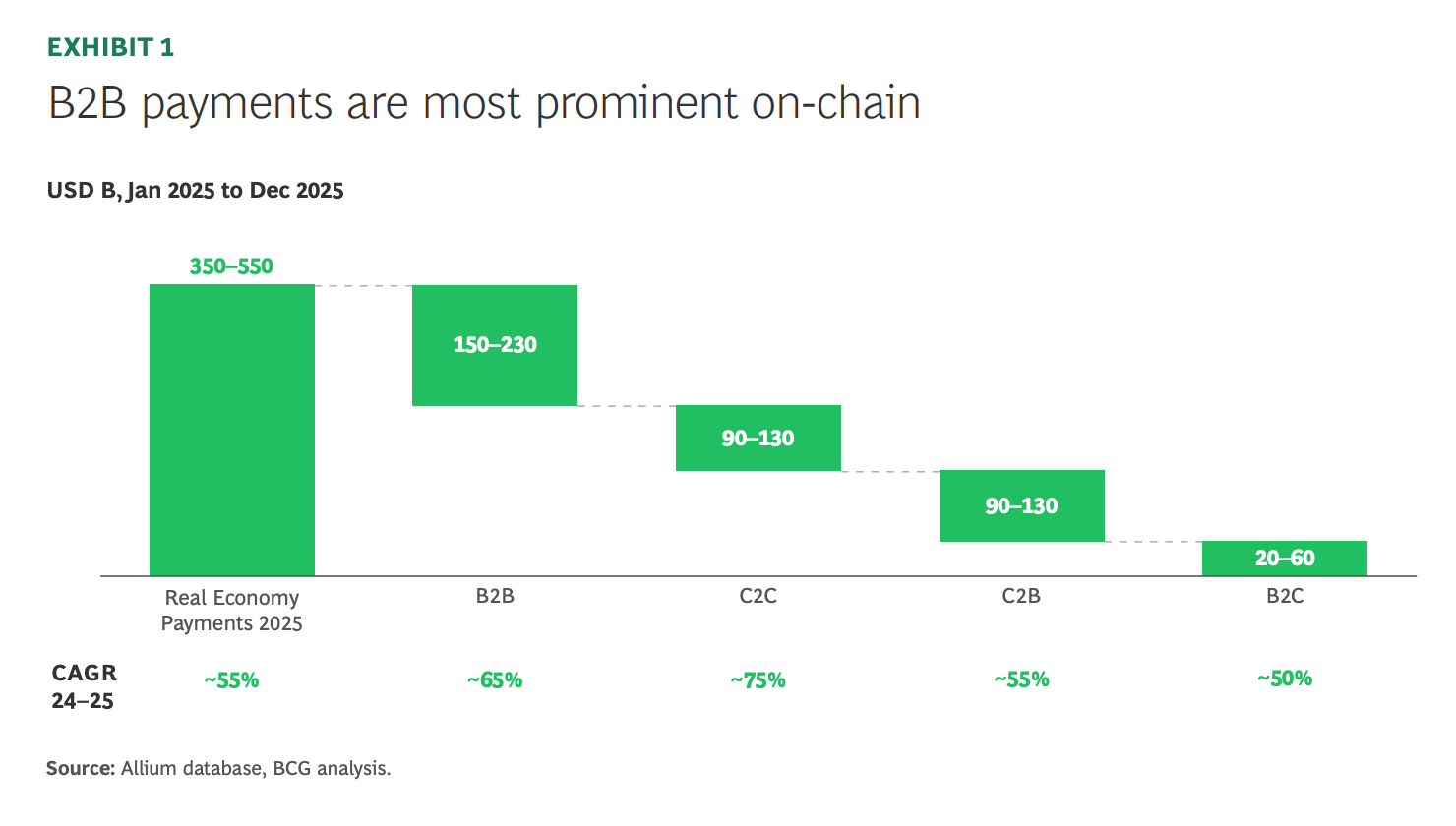
The latest whitepaper published with BCG, Stablecoin Payments: The Truth Behind the Numbers, examines how stablecoins are being used in the real economy today. The analysis estimates $350–550B in on-chain payments in 2025, led by $150–230B in B2B activity, with consumer flows contributing another $200–320B.
If you’re producing institutional crypto research or analytics, start with trusted data. Explore a live demo.
In this newsletter:
✨ Introducing Press Publish ✨
Russian stablecoins in Africa
Stablecoins and politics
Assorted links: conspiracy theories, reading lists, book clubs, loneliness policy, crypto bros and writing a bestseller.
Weekend: Glass blowing
Some of the topics discussed in this week’s premium dailies:
Coming up this week: jobs and inflation
Monday mood: the China question
Markets: incoherence
Macro: US consumer sentiment
Russia’s evolving crypto narrative
Markets: geopolitical swings
Macro: euro inflation and the coming crunch
Bitcoin and the quantum threat
Market: ingrained optimism
Macro: US jobs
Coming up this week: inflation and geopolitics
✨Introducing “Press Publish” ✨
🔦New section 🔦 Term of the day: Strait
Monday mood: Iran, stablecoins and the digital yuan
Markets: thick confusion
Macro: US jobs
Term of the day: decimate
Russian stablecoins in Africa
Markets: the talk
Macro: US services activity
Term of the day: naphtha
Markets: the relief
The geoeconomics of bitcoin-backed bonds
Term of the day: Brent
Markets: now for the post-relief?
Macro: behind the inflation expectations
Toll payment in bitcoin
Terms of the day: narratives vs themes
Stablecoins and politics
Markets: hopium
Why Satoshi’s identity matters
Macro: US PCE inflation
✨ Press Publish with Christine Kim
So, I did it! On Friday I launched a Substack live series 🎥 – not on crypto nor macro (coming soon!), but on writing newsletters.
There’s no-one I’d rather have kicked this off with than my friend and former colleague Christine Kim, one of the leading experts on the Ethereum ecosystem, now also covering Bitcoin, and the author of the ACD After Hours and BTC Before Light newsletters, host of the Ready for Merge and the Meet the Developers podcasts, and more besides. (You can see her recent publications here.)
We talked about why she left a good job with a good salary to dive into the harsh and yet satisfying world of content production, what she would have done differently if she could go back in time, what she loves, what she finds frustrating, what advice she’d give anyone starting out in this field, and a whole lot more. We can all learn from Christine’s experience and courage.

✨NEXT UP: ✨
Come join me next Friday, April 17th, at 11am ET when I talk to Brady Dale, who recently left a high-profile newsletter writing gig at Axios to branch out on his own – we’ll dive into why, how self-production is different, what advice he’d give anyone thinking of doing the same, and more.
(Some of you may have gotten an invite when I scheduled the session earlier today, and I got the date wrong, sorry – still getting the hang of this – 🎥 it’s on the 17th 🎥, not the 18th.)
Russian stablecoins in Africa
Regular readers will know that I often write about the role of stablecoins in geopolitics. They don’t just represent a potential extension of the reach of the US dollar, further cementing its role as a global store-of-value and trading currency. They also facilitate the use of dollar alternatives, potentially weakening both the dollar’s international position and the power of the US and other western powers to punish uncooperative nations by cutting off their access to the dollar-dominated system.
One example I’ve cited a few times is Russia’s use of stablecoins in trade; its CBDC is due to launch later this year, but crypto assets including stablecoins have been legal for cross-border settlement since mid-2024. With most of Russia’s banks sanctioned, this has been a lifeline for many of its businesses.
Of course, Western powers have tried to stop this. Last year, the EU applied sanctions to one of the key local stablecoins powering Russian cross-border trade: A7A5, pegged to the rouble. At the time, I wrote that this was a futile move as the entities using the token weren’t going to care much about a few more sanctions. And anyway, a stablecoin is just a few lines of code, easy to copy and paste under a different name. (I’m simplifying, of course, but the point that they are not hard to replicate holds.)
Indeed, the sanctions don’t seem to have worked. A7A5 today is the 21st largest stablecoin in circulation by market cap and has considerably more market cap than the largest euro stablecoin EURC, according to data from DeFiLlama.
What’s more, its operations are expanding.
The Financial Times reported earlier this week that A7 – the Moscow-based business behind A7A5, owned by sanctioned Moldovan banker Ilan Shor and the sanctioned Russian state-owned lender Promsvyazbank (PSB) – was recruiting for operations in Africa. Specifically, it had posted a search for someone to build a business “from scratch” in Togo.
In case anyone thinks this is just a Russian fintech setting up satellite offices, last year the firm expanded to Nigeria and Zimbabwe. According to the Centre for Information Resilience, the new offices were officially opened by Russian Deputy Finance Minister Ivan Chebeskov and Promsvyazbank Deputy Chairman Mikhail Dorofeev, and Russian media reported that the ceremonies were attended by the host countries’ finance ministers.
While a small country on the west coast of the continent, Togo has strategic significance for Russia. Last year, the two countries signed a military cooperation agreement, and Russia reportedly views Togo as an entry point for deeper West African engagement – it plans to open an embassy in the country this year.
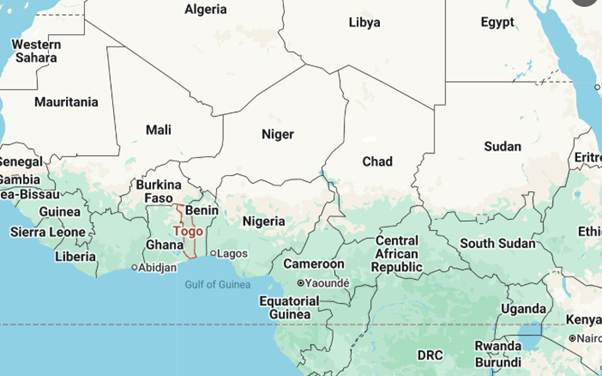
But take a look at where Togo is on the map: right below the Sahel, a band of countries stretching across northern Africa, in which – via a series of coups and other patterns of domestic unrest – Russia has managed to gain a strong foothold in terms of military and commercial influence.
Also, Togo has a modern deep-water port which, obviously, most of the Sahel nations don’t. So, it’s not a stretch to see why Russia is interested in the country as a conduit for merchandise heading in both directions.
Much of this will need to be paid for. Given Russia’s banking restrictions, we can assume that it will continue to pressure trade partners to accommodate the use of rails the incumbent financial system can’t shut down.
See also:
Sanctions on a stablecoin (Oct 2025)
The dark side of crypto (June 2025)
Why the coup in Niger matters for crypto, by way of a mission statement (Aug 2023)
🌸 If you find this newsletter useful, would you mind sharing it with your friends and colleagues and nudging them to subscribe? I’d appreciate it! 🌸
Stablecoins and politics
Earlier this week, the White House Council of Economic Advisers (CEA) published a study on the potential impact of allowing stablecoin issuers to offer yield on balances.
I confess I haven’t had a chance yet to read the full report, but going from the Executive Summary, it concludes that any cost to lending would be minimal (an impact of around 0.02%), and the cost to consumers from banning yield would be a considerable “net welfare cost” of $800 million.
In sum, the CEA dismisses claims that lending would suffer a meaningful hit, and argues that allowing stablecoin yield would be beneficial for the US economy, which indirectly would also benefit banks. This is contrary to claims from the banking industry that their ability to lend and therefore support the US economy is under threat.
The main takeaway here is how political this issue is. Of course, the CEA’s report is full of untested assumptions, as is the banking industry’s opposition. What’s interesting is the divide between the Administration, which sees benefit in limiting the influence of banks, and Congress, whose representatives are more swayed by arguments hitting local economies, and who often get donations from bankers for their political campaigns.
Of course, crypto enthusiasts pushing for the ability of stablecoin holders to earn a return are pointing to this report as vindication. It’s not. Predicting future impacts is not a science.
Rather, the report feels like messaging from the White House to the banking industry: we’re against you on this. Of course, anyone listening to Treasury Secretary Scott Bessent’s breathless predictions of stablecoin growth and what that will do for both dollar hegemony and demand for US treasuries already knows this. But the banking industry has been acting as if it doesn’t.
To drive the point home even more forcefully, Bessent wrote an op-ed for the Wall Street Journal, published on Wednesday, in which he rails against the banking industry’s attempt to take financial innovation hostage.
Here’s a sample quote:
“The U.S. didn’t become the world’s financial center by hesitating in moments of technological change. It led by setting standards that others followed.”
So, US banks vs the Administration? This is not new – US political history is peppered with the tussle between centralized financial power and the outlook for the average American individual. It still astonishes many of us Europeans that it is now the Democratic Party fighting to perpetuate entrenched interests.
What is new is that this is not so much about breaking a monopoly and redistributing the opportunity, although there is obviously some of that. It’s also about how much power the US government should have relative to Wall Street.
Because what does stablecoin demand translate into? Demand for US Treasuries. More demand for US Treasuries brings down rates, stimulates the economy, and gives the Administration not just the political win, but also more spending power which translates into a greater influence on the US economy. No wonder the US Treasury Secretary is so enthusiastic about growth in stablecoin demand.
Back to the CEA report – of course it’s not conclusive, but I don’t mean to belittle its significance: it is a useful addition to the pro-innovation arguments, especially now that banking lobbies will have to work harder to justify their predictions if they want to debunk the CEA’s.
Personally, I don’t think the stablecoin rewards issue should hold up the CLARITY Act. I also don’t think idle stablecoin balances should be able to earn meaningful interest – there are other ways they can get yield, and greater demand for those opportunities would encourage further development of DeFi applications, tokenized money market funds and so on.
But I bristle at the banks thinking that they can play victim here and use underhand tactics to reinforce their extremely profitable moat.
Still, the most they can do is delay the inevitable monopoly-busting force of innovation. The Administration has levers it can pull, influence it can sway, and a powerful message to repeat and repeat and repeat: at stake is no less than American dominance of finance and technology.
See also:
Stablecoin rewards and bank deceit (March 2026)
Stablecoin yield compromise? (March 2026)
ASSORTED LINKS
(A selection of reads I came across this week that I think are worth sharing, not always about crypto or macro. I try to choose links without a paywall, but when I feel it’s worth making an exception, I specify.)
Arthur Brooks tackles the thorny subject of why we are fascinated by conspiracy theories – it’s about our instinctive need for coherence in our lives, and when things don’t make sense, we’ll grasp at any reason. (Why Your Neighbor Became a Conspiracy Theorist. And Maybe You, Too, The Free Press – paywall with free trial)
Ted Gioia answers questions about his 52-week classics reading program, diving into the relevance of old texts, unearthing some modern gems, how the art of cinema tends to be left out of the culture discussions, and more. (How to Read the Great Books in 52 Weeks, The Honest Broker)
There have been signs building that reading books is becoming “fashionable” again. But reading as a social activity? That’s a new one for me, and I kinda love the idea. (People Are Paying $1,000 to Read Among Strangers, Bloomberg – paywall)
If loneliness is an increasingly serious social problem, then shouldn’t governments be doing more to combat it? Alex Mayyasi has some intriguing ideas about how they could do that, and dives into why so many arts and other social businesses are struggling in this hyper-productive age. (Why ‘Cost Disease’ Is the Secret Force Behind America’s Toxic Solitude, Derek Thompson)
As a woman in crypto, I’ve always hated the term “crypto bros”, although I get that it describes a certain blinkered enthusiasm born from a conviction that the idealistic are always right. So, I enjoyed Brady Dale’s dissection of the negative connotations of the term, and how it’s thankfully fading. (We need to talk about calling people “bros”, Front Stage Exit)
A podcast episode: Andy Weir – author of the books The Martian and Project Hail Mary – talks about how and why he writes, how the Project Hail Mary film (strong recommend) came about, and more. Refreshing. (Andy Weir on Writing the Hit Book Behind the Movie ‘Project Hail Mary’, The Book Review podcast)
HAVE A GREAT WEEKEND!
(in this section, I share stuff that has NOTHING to do with macro or crypto, ‘cos it’s the weekend and life is interesting)
One of my secret obsessions is glasswork, the act of creating glass sculptures and vessels. From a blob of nothing, a smooth and transparent fantasy can emerge, whose delicacy masks the brute force of strength and fire required to make it. And I’ve often told my family that, when I retire, I want to become a glassblower.
So, today – since I’m pretty sure we could all use a reminder of how not all beauty is ephemeral – I’m going to share a few videos which highlight the artistry and the glow of glass creations. Just breathtaking.
DISCLAIMER: I never give trading ideas, and NOTHING I say is investment advice! I hold some BTC, ETH and a tiny amount of some smaller tokens, but they’re all long-term holdings – I don’t trade. Also, I often use AI for research instead of Google, but never for writing.